


Live in Placard # 7
|
Basic Information Tracklist: |
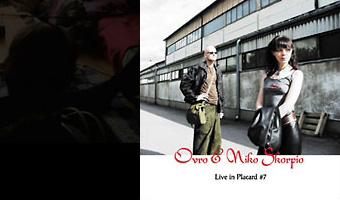 < [ BUY THIS FROM ME ] |
[ FURTHER INFORMATION ] [ REVIEWS ]
The Wire:
"The album contains the solo and combined contributions of Ovro & Niko Skorpio to the Placard Festival. These festivals are only made available on headphones, either by MP3 or live streams over the Internet, to locations either nearby or remote. On this occasion the performance took place in a Helsinki apartment, convenient for the Finnish artists, with listening slots (the "placards") set up in France, Belgium and Italy. Therefore the conditions of its original performance are entirely replicable at home.
Headphone listening greatly heightens awareness of stereo. This is exploited throughout, pre-eminently by using stereo panning with a vigour and agandon rarely heard since the technique's adoption by the mass market. Likewise, radical separation in each channel is often made apparent by rapid on-off sequences.
Ovro's half develops with more convincing aesthetic with these tools. "Pre-Concrete Echoes", for example, mixes muted thumps and echoes together with helter skelters of purely electronic and purely synthetic sound. It is like listening to the infrastructure of a building, with wires, pipes, walls and joists conspiratorially crepitating to each other. Over this, Ovro whispers barbed threats in a little girl's voice. It is a piece born to live in the intimacy of the headphones, never taking the listener beyond the space between their ears.
Niko Skorpio's pieces are both more musical and more robust. The collapsing building sounds on "Oskorei", or the Eastern wind riff on "Liminal Cows", or the recognisable guitar and percussion sounds throughout, take our minds to the source of their creation. The standout track, however, brings both artists together on "Dreams Which Burn", a telling title for a piece where Ovro's paranoid and unresolved soundscapes are buffeted by Niko's sonically fiercer leanings to produce a distubingly scorched nightmare.”
Frans de Waard in Vital Weekly
"(...)Like I wrote before there are similarities between the sound of Ovro and AGF in a way that both deal with vocals, or maybe rather spoken words. Poetic electronic music. It's hard to decipher what these poems are about, but hearing the somewhat darker undercurrents in her music I bet it's not a happy worldview. The musical setting is mostly on the quieter side of electronics. After her live recording follows an improvised piece with Niko Skorpio, which combines the best of both worlds, but less the vocals.
Niko Skorpio is an established artist on the Some Place Else label, and he uses sampling to a great extend with noise elements and slow rhythms. When Skorpio puts his Reptiljan cap on, things turn grim with a bunch of laptop grindcore. Two examples are enclosed here too. It makes the entire disc into a well-done, well varied bunch of electronic music by two of the more promising artists from Finland."
Phosphor Magazine
"The recording heads off rather calm with Ovro's material, featuring dark minimal low key sounds and noises with on top of it a narrative female voice reciting in a slightly childish fairy-tale way. The music slowly gets more robust during this album. Electronic, psychedelic and mysterious sampled noises form the main core of the music. It's like Alice in Wonderland is communicating with aliens that speak in dark crackles and strange hiss. It's not often one comes across such music, implying the originality of it of course.
But the album offers much more, being the output by Niko Skorpio. An unrecognizable voice on top of digital distorted sound bits, creating creepy soundscapes and ominous atmospheres. The last couple of tracks can even be considered feeback noise, reminding of artists such as The Haters or noise without any sign of structure. This is more the territory of one of the other projects called Reptiljan."
Vizgig in TiK Distro:
"This release I found to be less exciting than Ovro’s Malice in Underland, however it is still wholly worth hearing and still retains some of the strangeness, strength and wonder. Many of the songs from Malice are repeated in live versions, which are of equally high quality. I think what taxes my interest is the cleaner quality of recording and production which is antithecal to Malice’s power in lo-fi sound and bizarreness in the hissy crackle of lower end experimentation, forcing the listener at times to wonder if it is just a total fuck around with no music made strictly from found sounds. However with the production on Placard, that element is lost, the tracks sound very synth based and miss a sort of eerie resolve; that forceful questioning and melancholy brooding. Yet by no means is this a total condemnation of said album. The tracks are still excellently executed, the sounds are still emotionally appealing sensory attacks. And I haven't even mentioned the second artist on here. Niko Skorpio is a nice juxtaposition to Ovro's sound, as they make a more majestic but equally as menacing mess. While Ovro's ambience has a coldly schizophrenic, more melancholy feel, Skorpio sounds a bit more toned psychedelic, while managing a certain anthematic quality. The mood transitions very nicely with a collaborative track, which showcases elements of both styles. A nice ambient mess of sounds. Overall makes nice chill out music. Truly headphone music for headphone people. However for me a lot of the originality is lost in trying to make a smoother sounding album. Not necessarily a bad thing, but I'm petty."
Jiituomas in Kuolleen Musiikin Yhdistys
"This is the expanded, two-cd version of live material performed by Ovro and Niko Skorpio in Helsinki the 22nd of May, 2004. In a sense the main disc contains four performers, as both artists have a joint set between their separate works, and Niko Skorpio also does a few tracks as Reptiljan. The album gets started with Ovro, whose material is still very much like that on the badly failed debut album (Malice in Underland, 2003). Despite the weak foundation, Ovro draws out absolutely everything that is possible from it, and thus that "vocal microsound" finally gets to the state where it should have been in the first place. Ovro's eight tracks form a splintered but oppressive package of minimal sound states, one that does not impress as compositions, but easily surpasses the problems with the sheer quality of the performance. This is followed by a single SkorpiOvro-track, the stylish Dreams Which Burn. It nicely moves the evening towards the second show with clanging sound waves.
Niko Skorpio's material is - if at all possible - even more raw. It flows between scenic material and minimalist clicks'n'cuts stuff. There's a lot of excellent style (such as in the very clever Liminal Cows), but has an unfortunately low level of impact. Whereas Ovro's show practically pulsed with energy, Skorpio's is static performance. The situation doesn't really change even when he, as Reptiljan, later gets clearly harsher. Again the point of transition between artists (this time it's Oskorei (invoking Reptiljan)) is much stronger material than the surrounding works. The great soundscapes of Skorpio's show nevertheless easily sustain it the whole way.
The limited luxury edition of 23 copies comes packed within a remarkably well made faux leather pocket, and includes a second disc., a cd-r with two Skorp-I-Ovro (note the different spelling) recorded later in 2004, as well as Ovro's great video background from the same year's spring. The tracks are a notably fascinating, strange fusion of the individual styles of both artists. They feel weird, in the sense of sounding extremely much like Ovro's and Skorpio's work - despite the fact that neither of them has a style that's limited enough to be compressed into such a narrow definition. The songs on Eq-I-Nox are very evocative, even when their actual contents are ricocheting to several different directions at once. As singular works they function better than the material on the main disc, but on the other hand have a much more clinical feel to them.
Despite its flaws, Live in Placard #7 / Eq-i-Nox is a very good live record, and an excellent purchase. The feel of the show reaches listeners very well, and helps to feel the music exactly the way it was originally meant to be. The biggest problem these discs face is not due to any fault of their own: it's the fact that both artists have recently published live albums that are far superior works (Ovro's brilliant The Serpent Rite and Niko Skorpio's nearly perfect The Book of Flies), and it's simply not possible for this package to compete with those.
Measured purely on its own, this is a very fine double album. Measured against the performers' other works, it's only average."